DELIVERY CASE · PRESSURE VESSEL CUTTING AUTOMATION · 2026
Jiangsu Qianli Machinery Adopts a Robotic Dished-Head Hole-Cutting Cell — One Machine for Head Openings, Shell Saddle Cuts and Plate Cutting
haibao robot delivered a robotic plasma cutting cell for dished-head hole cutting to Jiangsu Qianli Machinery Co., Ltd., an A2-licensed pressure vessel manufacturer. The cell pairs a TKB1800 robot with haibao robot’s HB Pro-260 fine plasma power source and cuts carbon and stainless steel up to 26 mm. Measured under identical conditions, overall throughput is 3.2× that of the former manual layout + manual cutting + grinding/rework process.
☎ Call +86 177 5158 3908 Send drawings for a proposal →
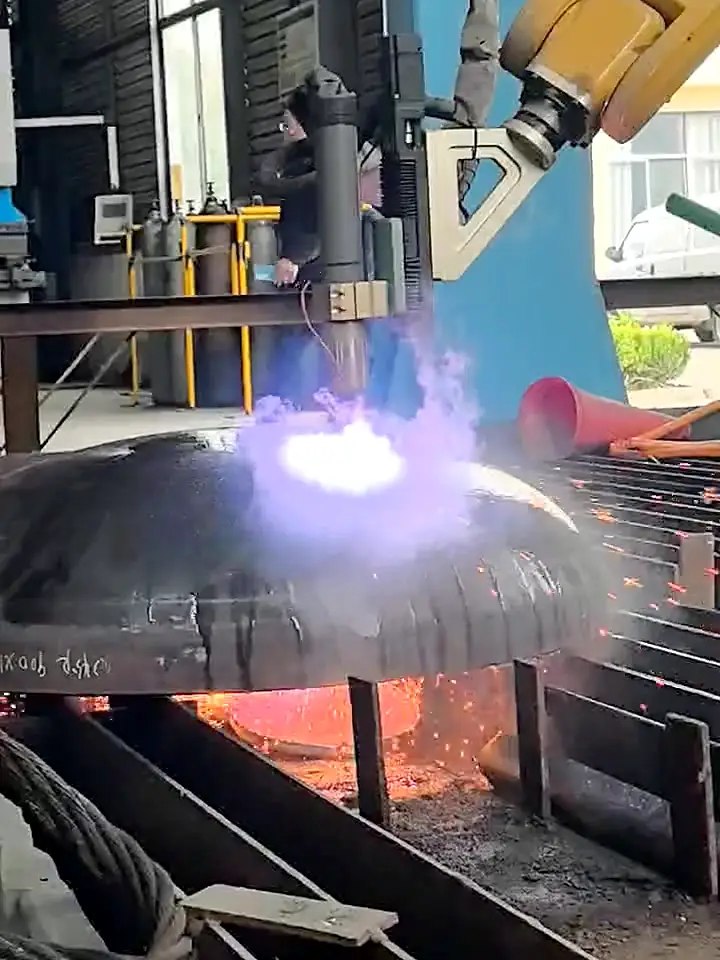 On-site footage
3.2×Overall throughput
measured on site, like-for-like
26mmMax. stable cutting thickness
carbon / stainless steel
3in 1Head openings · shell saddle
cuts · plate cutting
1cellCovers three core cutting
operations in vessel fabrication
On Site
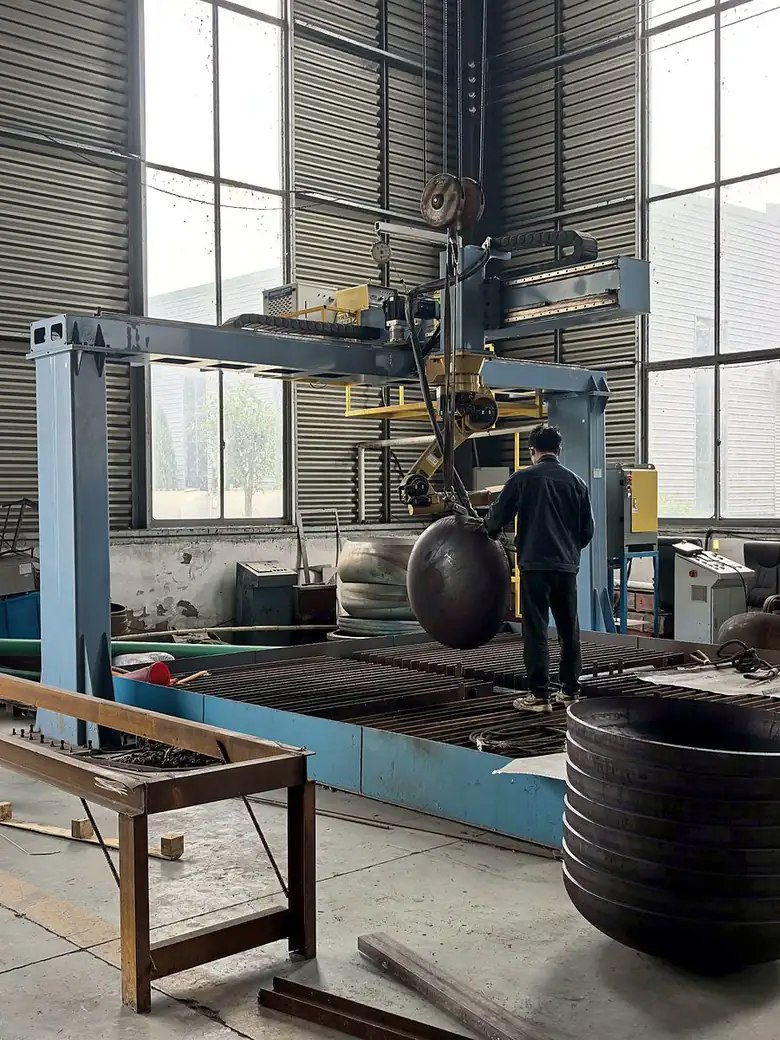
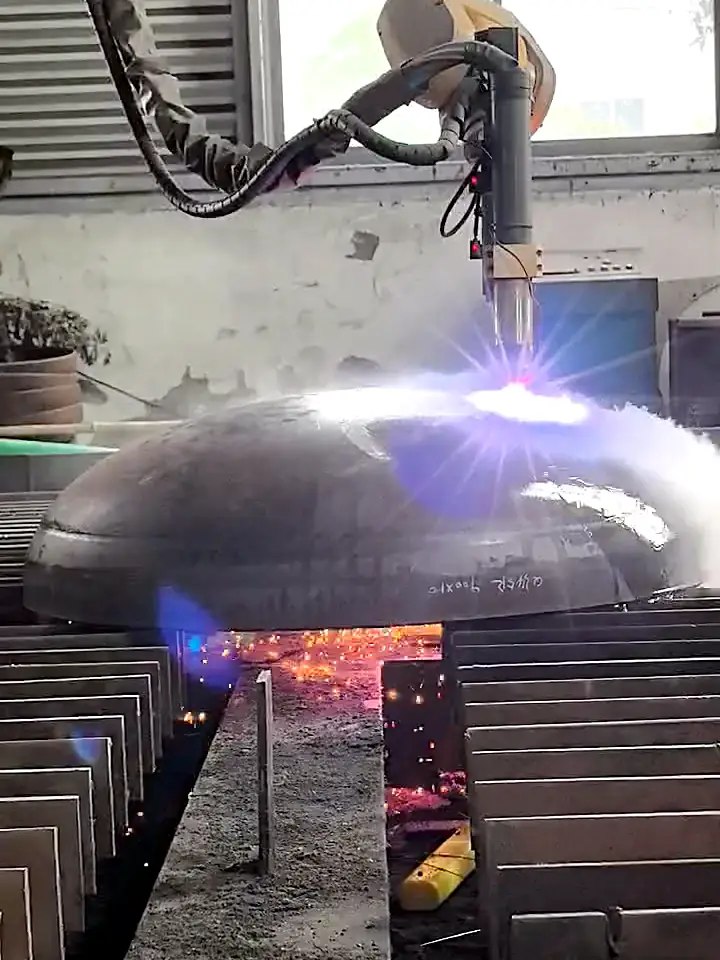
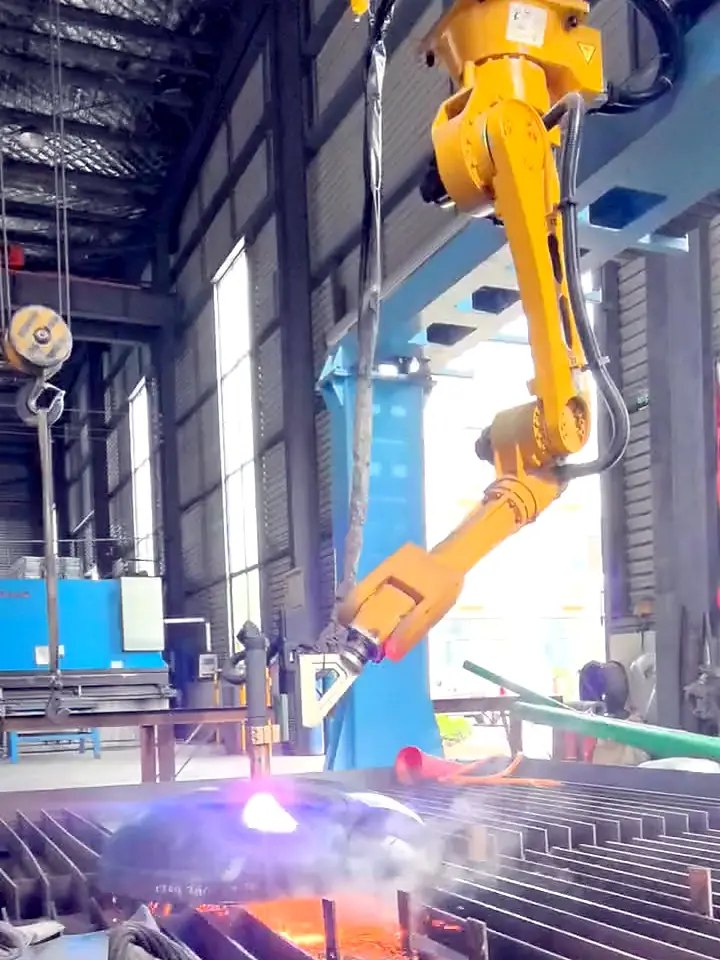
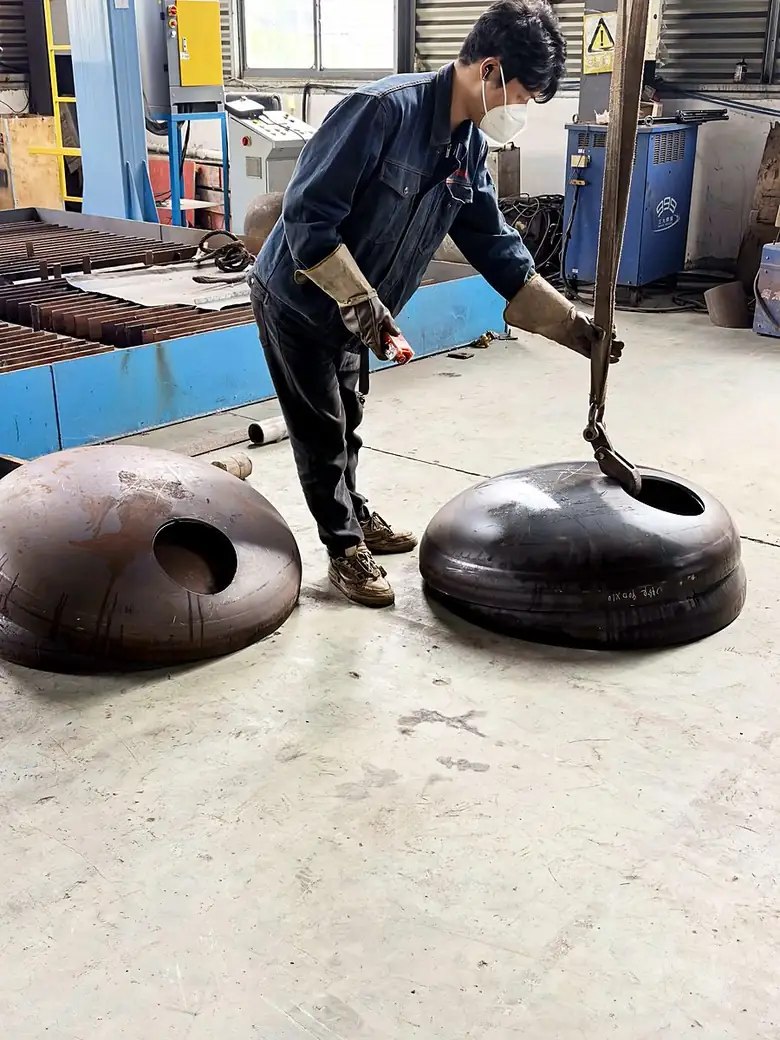
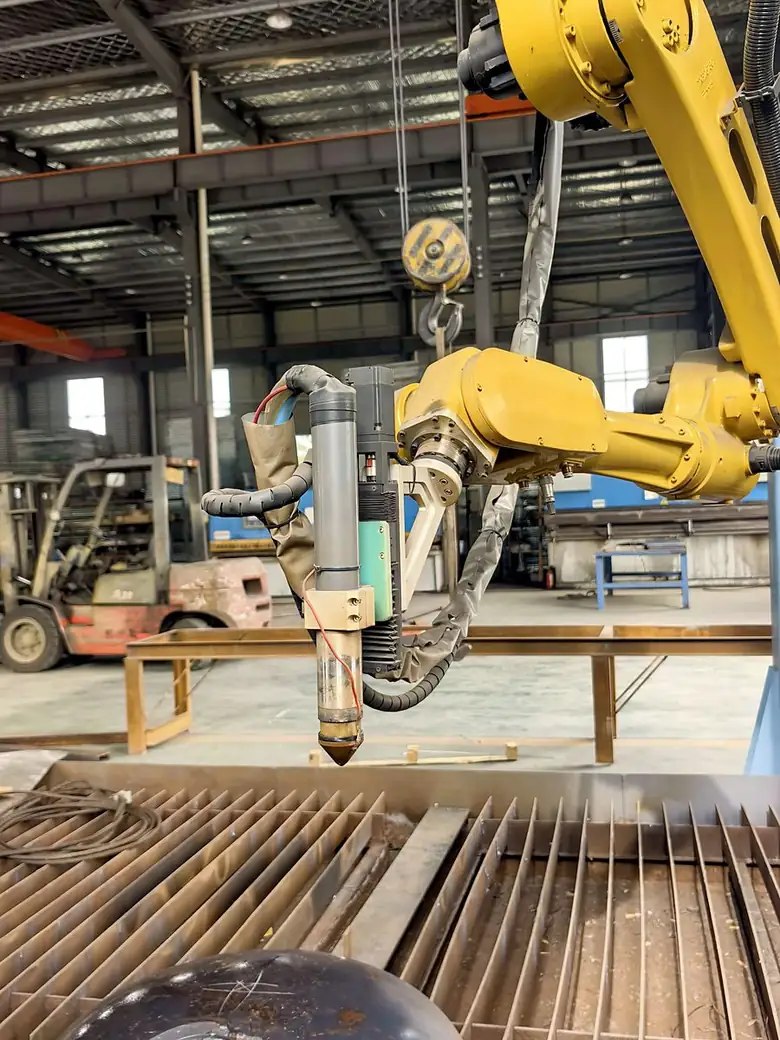
On-site photos: the robotic cutting cell at Qianli Machinery
All photos and video stills below were taken in Qianli’s production workshop after delivery, with the cell in regular production.
Case summary
A robotic head hole-cutting cell is an industrial robot carrying a plasma torch that automatically cuts openings and weld bevels along the 3D surface of a dished head or vessel shell. It replaces the traditional “manual layout + manual plasma cutting + grinding/rework” workflow in pressure vessel shops. In this case, Jiangsu Qianli Machinery uses a single haibao robot cell for three operations: head openings, shell saddle cuts and flat-plate cutting.
Customer: Jiangsu Qianli Machinery Co., Ltd. — Jiangsu SRDI enterprise, High-Tech Enterprise, A2 pressure vessel manufacturing license
Problem: high-mix, low-volume custom tanks; openings and saddle cuts depended on skilled workers and capped output
Configuration: TKB1800 robot + HB Pro-260 fine plasma power source, max. stable cut 26 mm
Result: 3.2× overall throughput like-for-like; consistent bevels, less rework, lower labor intensity
Client
The customer: a custom pressure vessel maker with high product mix
Qianli builds fermenters, stainless steel storage tanks, reactors and silos for the food, pharmaceutical and environmental biogas industries. Most orders are high-mix, low-volume custom tanks — nearly every batch of heads and shells has different opening positions, diameters and bevels, which rules out dedicated dies or fixed tooling.
Jiangsu Qianli Machinery Co., Ltd.
A2 pressure vessel license Jiangsu SRDI enterprise High-Tech Enterprise
Products
Fermenters, stainless storage tanks, reactors, silos and other custom pressure vessels
Industries
Food, pharmaceutical, environmental biogas
Order profile
High-mix, low-volume custom tanks
Equipment
Robotic head hole-cutting cell (haibao robot)
The Bottleneck
Why do head openings and saddle cuts choke shop throughput?
A dished head is a doubly curved surface; a shell saddle cut is the 3D intersection curve of two cylinders. Done by hand, layout accuracy, torch angle and travel speed all depend on the worker — and every error carries into the bevel and the downstream weld.
BeforeManual layout + manual plasma
Layout→Manual cut→Grind / rework→Weld
Relies on skilled welders who are hard to hire; quality shifts with staff
Large layout errors on curved surfaces; inconsistent hole position and shape
Heavy dross and burrs mean extensive grinding and rework
Long hours of layout and grinding in dusty conditions
Afterhaibao robotic hole-cutting cell
Load & locate→Robotic 3D cut (with bevel)→Weld
Programmed torch path gives consistent bevels and controlled cut quality
Downstream grinding hours cut substantially; less rework
Workers freed from repetitive layout and grinding
One cell handles three operations — fast changeover for mixed orders
Solution · 3-in-1
One cell for the three core cutting operations of vessel fabrication
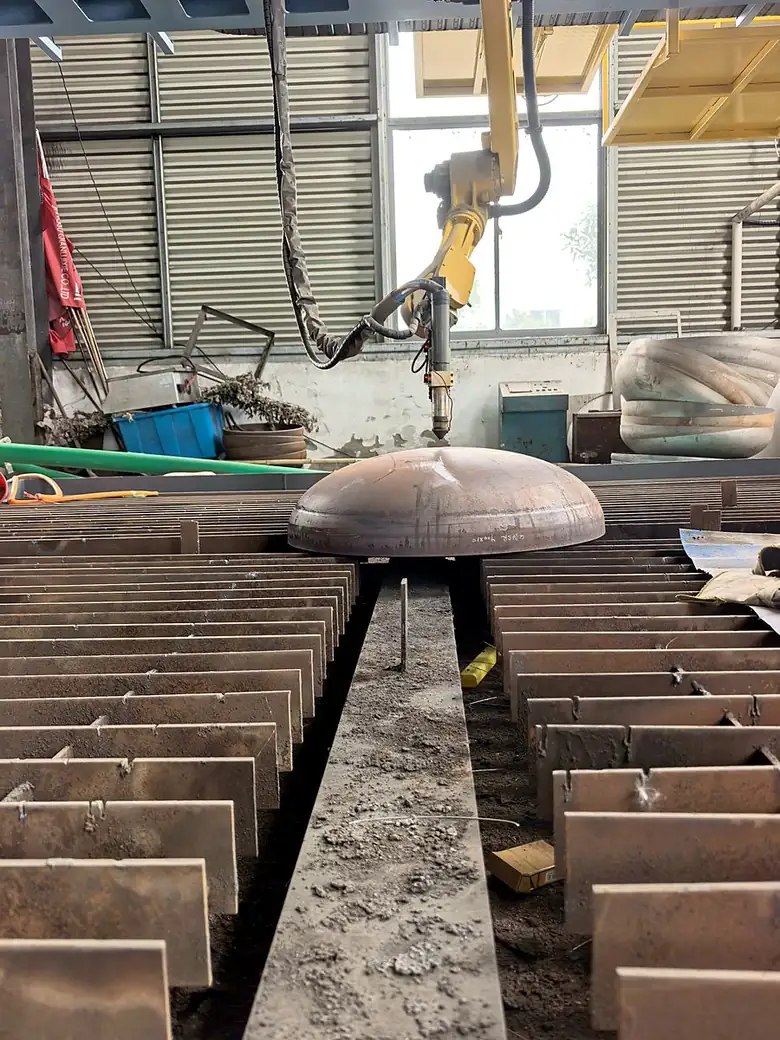
The cell is not limited to head openings. Qianli also runs shell saddle cuts and plate cutting on the same machine — a decisive advantage for a custom tank shop with scattered, ever-changing orders.
01
Head openings
Nozzle and manway holes in elliptical or torispherical heads, cut along the 3D surface, with bevels where the procedure requires.
02
Shell saddle cuts
The saddle-shaped opening where a nozzle meets the shell is a true 3D curve — the hardest to repeat by hand, and far more consistent with a robot path.
03
Flat-plate cutting
The cell also cuts flat plate, so it never sits idle when head orders are light — higher equipment utilization.
Configuration
Cell configuration in this project
The robot handles the 3D path; the fine plasma source determines cut quality. Together they set hole accuracy and bevel consistency.
| Equipment | Robotic dished-head hole-cutting cell |
|---|---|
| Robot | TKB1800 |
| Power source | haibao robot HB Pro-260 fine plasma |
| Max. stable cut | 26 mm |
| Materials | Carbon steel, stainless steel |
| Operations | Head openings, shell saddle cuts, flat-plate cutting |
| Process capability | Meets bevel-cutting procedure requirements |
| Supplier | haibao robot |
* Configuration as delivered for this project. Process parameters for other head sizes, thicknesses and materials are confirmed by technical agreement and trial cuts.
Results
Results: 3.2× overall throughput — and how that number was measured
Like-for-like overall throughput (baseline = 1.0)
Manual layout + manual cut + grind/rework1.0
haibao robotic hole-cutting cell3.2×
Baseline
Qianli’s former full process: manual layout + manual cutting + grinding/rework
Conditions
Same material, same thickness, same number of openings, bevel required
Scope
Overall throughput including downstream grinding/rework — not cutting speed alone
Source
Measured in production at Qianli; accepted by both buyer and project team
01
Consistent bevels
Controlled cut quality gives the downstream weld a uniform joint preparation.
02
Far less grinding and rework
Fewer burrs and dimensional deviations; post-cut grinding drops sharply.
03
Less dependence on skilled welders
Cut quality no longer hinges on a few veterans; staff turnover matters less.
04
Shop capacity released
Cutting is no longer the bottleneck; component quality is more stable.
We build fermenters and pressure vessels, and cutting openings in heads and shells has always been a headache. Since this haibao robotic cutting cell went in, curved-surface openings, shell saddle cuts and plate cutting all run on one machine — it’s very versatile. Cut quality is stable, rework is down, and our workers no longer spend long hours laying out and grinding in the dust. For our multi-spec custom tank production, it’s a genuinely practical automation upgrade.
Is It For You
Which shops should consider a robotic head hole-cutting cell?
If your shop matches any two of these, cutting is probably your bottleneck — worth a proposal review.
Custom vessel makers
Fermenters, tanks, reactors, silos — many openings in varying positions on heads and shells.
High-mix, low-volume
Frequent spec changes; dedicated tooling for one size doesn’t pay.
Bevels required
Openings go straight to nozzle welding, so bevel consistency matters.
Skilled labor shortage
Layout and manual cutting rely on veterans; grinding eats hours.
FAQ
Robotic head hole-cutting cell: frequently asked questions
What is a robotic head hole-cutting cell?
It is a complete cutting system made up of an industrial robot, a plasma power source and torch, and a cutting table. The robot carries the torch along the 3D surface of a dished head or vessel shell and cuts automatically, replacing manual layout and manual plasma cutting. Typical uses are head openings, shell saddle cuts and flat-plate cutting in pressure vessel fabrication.
How thick can it cut, and which materials?
The Qianli cell combines a TKB1800 robot with haibao robot’s HB Pro-260 fine plasma power source. Maximum stable cutting thickness is 26 mm in both carbon steel and stainless steel. Other materials or greater thicknesses are evaluated case by case.
Can one machine cut both head openings and shell saddle cuts?
Yes. In this project a single cell handles head openings, shell saddle cuts and flat-plate cutting — the three core cutting operations in pressure vessel fabrication.
How was the 3.2× throughput figure measured?
The baseline is Qianli’s former full process of manual layout, manual cutting and grinding/rework. Conditions were identical: same material, thickness and number of openings, with bevels required. The figure covers overall throughput including downstream grinding and rework, not cutting speed alone. It was measured in production and accepted by both the buyer and the project team.
Does robotic cutting suit high-mix, low-volume custom tank shops?
Yes. Qianli’s orders are mostly high-mix, low-volume custom tanks. The cell needs no dedicated tooling and switches between heads, shells and plate. The more specs and the more scattered the openings, the higher the cost of manual layout — and the bigger the payoff from automation.
How does robotic cutting affect bevel quality and welding?
The robot follows a programmed path, so bevels are consistent and cut quality is controlled. Fewer burrs and dimensional deviations mean much less grinding and rework, and more uniform fit-up for nozzle welding.
What information does haibao robot need for a proposal?
Please provide head type and size (diameter, wall thickness), shell dimensions, opening/nozzle size and location drawings, material, bevel requirements and typical batch sizes. haibao robot will propose a cell configuration and a cutting feasibility assessment, with trial cuts where needed.
Why did Jiangsu Qianli Machinery choose haibao robot?
Qianli needed one system to handle head, shell and plate cutting across many custom specs. haibao robot’s cell combines a TKB1800 robot with haibao robot’s HB Pro-260 fine plasma source, covers all three operations in one machine, and after delivery has delivered stable cut quality with less rework.
Related delivery cases
VESSELS · OVERLAYStrip cladding automation cell delivered to Wuxi Zhongyue PetrochemicalLarge-area corrosion-resistant overlay on tubesheets and heads → VESSELS · WELDINGHalf-pipe jacket automatic welding station for Shandong ZhongfuTwin-torch symmetrical welding (in Chinese) → VESSELS · FORMINGAutomatic half-pipe forming machine for Anhui Saide QiruiUncoil — form — spiral wrap in one line (in Chinese) →
Contact · Get a Proposal
Your head openings,
handled by a robot.
Send us your head and shell drawings, and haibao robot will recommend a cell configuration with a cutting feasibility assessment. You are also welcome to visit haibao robot in Changzhou, China, to see the equipment in operation.
Head type & sizeShell diameter / thicknessOpening & nozzle locationsMaterialBevel requirementsBatch size
Key Account Project Director · International Welding Engineer (IWE)
Shao Yicheng
Emailmasterhyper@163.com
Hotline+86 519 8837 0688
AddressNo. 129 Yingbin Branch Road, Henglin, Wujin District, Changzhou, Jiangsu, China
haibao robot Welding & Cutting Co., Ltd. | Robotic head hole cutting · Shell saddle cutting · Fine plasma power sources · Pressure vessel welding & cutting equipment | Published.