News
Receiver & Oil Separator Robotic Welding Cell | haibao robot
Robotic Welding at the Customer’s Factory
Photographs from Wuxi Yongjian’s production site show robotic welding of shells, end caps and nozzles for refrigerant receivers and oil separators.
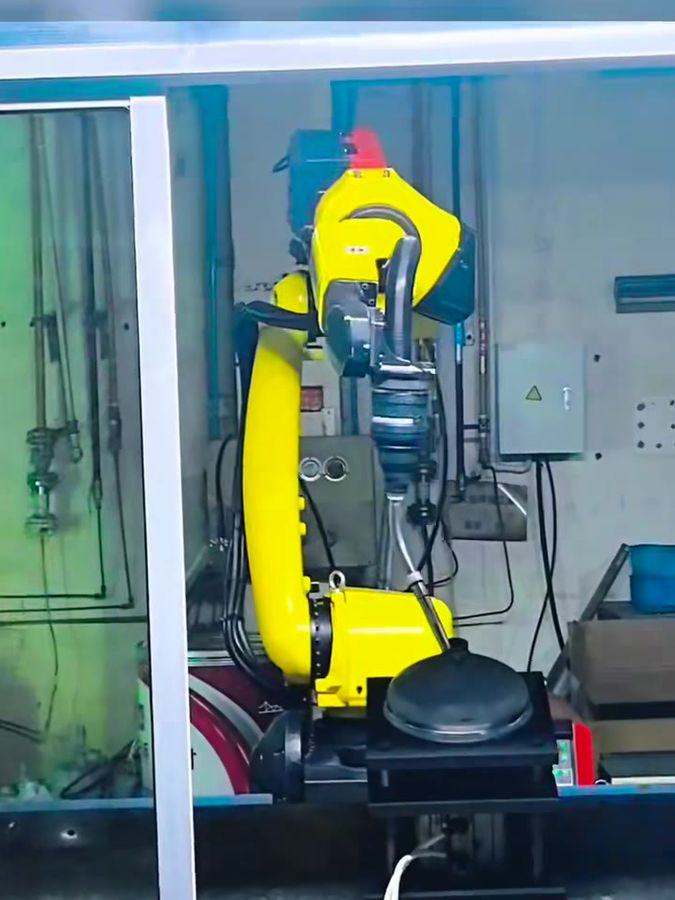 Complete welding cell Robot and rotary positioner | 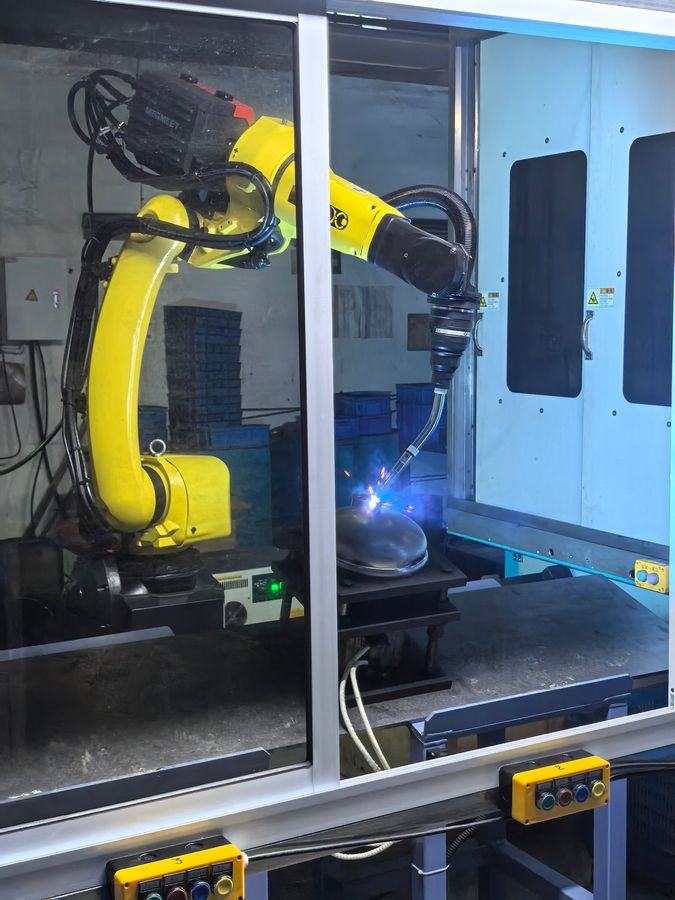 Circumferential end-cap welding Welding viewed through the observation window |
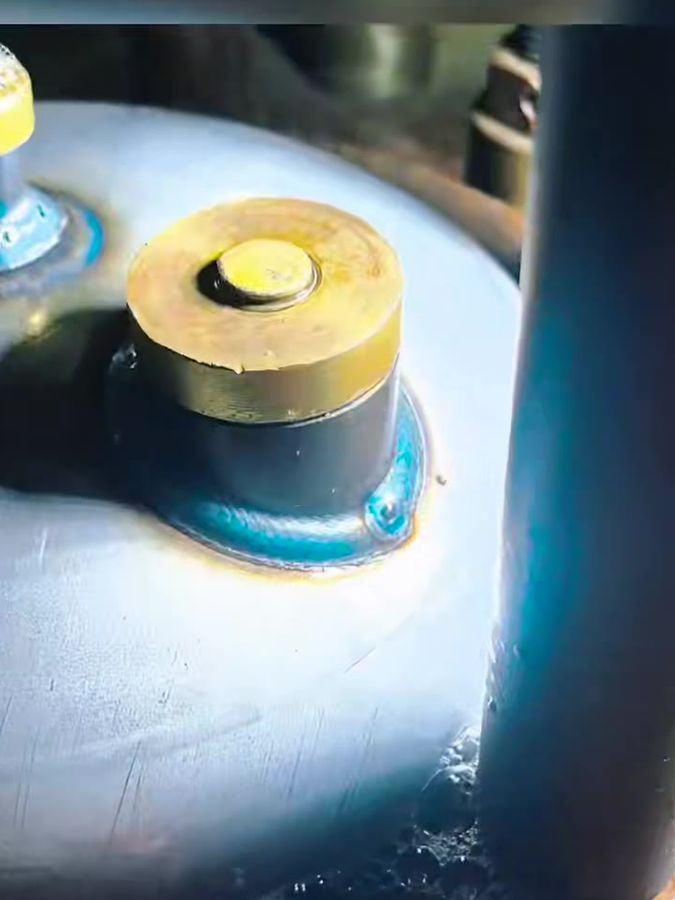 Nozzle fillet weld Full bead profile and even heat tint | 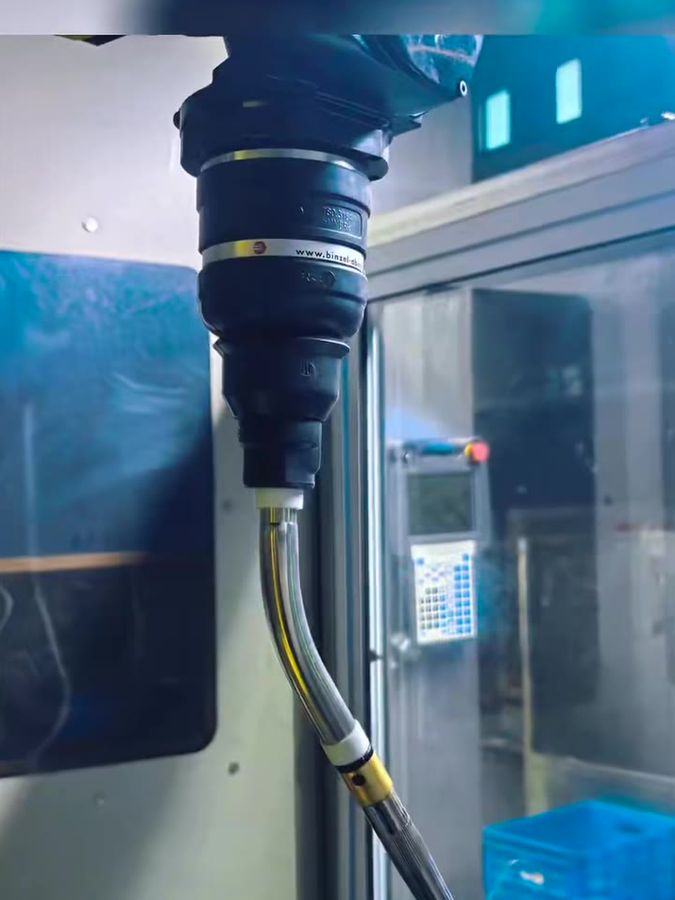 Torch and teach pendant German TBI torch with hollow-wrist cable routing |
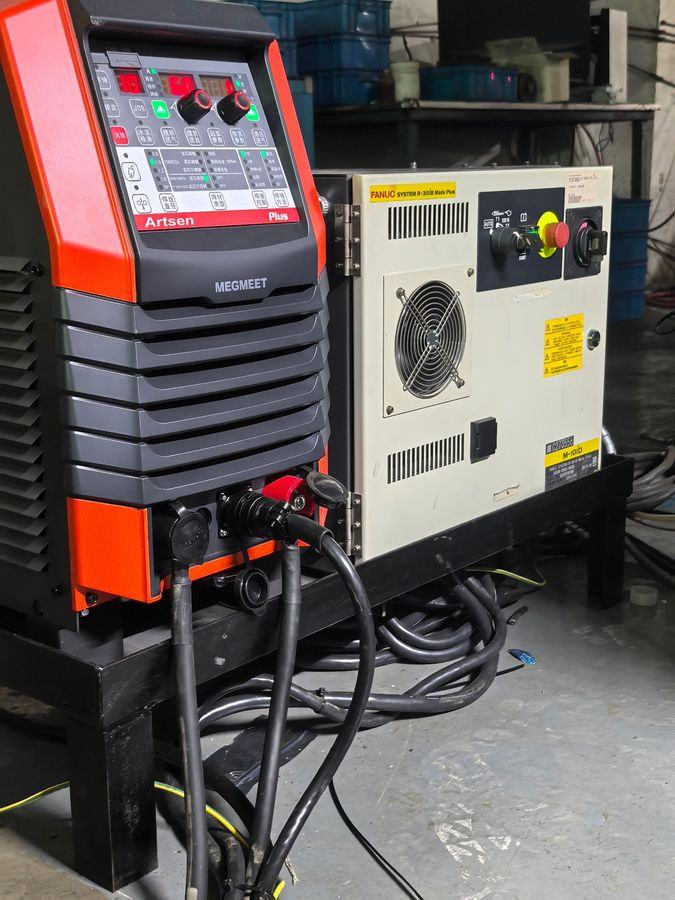 Power source and controller Artsen Plus and R-30iB Mate Plus |  Customer facility Wuxi Yongjian Metal Products Co., Ltd. |
CUSTOMER CASE STUDY · REFRIGERATION COMPONENTS
Robotic Welding Cell for Refrigerant Receivers and Oil Separators
Delivered to Wuxi Yongjian Metal Products
haibao robot · Complete project delivery, from workpiece analysis and fixture design to factory trials, on-site commissioning and operator training.
1cell Robot + rotary positioner | 3part types Receivers, oil separators and gas–liquid separators |
360° Positioner rotation for a continuous circumferential weld | 4weld types Longitudinal seams, end-cap seams, nozzle fillets and support feet |
Enclosed Protective enclosure screens welding arc and spatter | |
Project Overview
The application, production requirements and equipment delivered.
| Customer | Wuxi Yongjian Metal Products Co., Ltd. |
| Industry | Refrigeration and air-conditioning component manufacturing |
| Workpieces | Refrigerant receivers, oil separators and gas–liquid separators: thin-wall shells with end caps and multiple nozzles |
| Welding process | MIG/MAG gas-shielded welding with a MEGMEET Artsen Plus power source |
| Key requirements | Leak-tight circumferential and nozzle welds, consistent bead profiles and efficient changeovers between part sizes |
| Equipment supplied | FANUC M-10iD robot, R-30iB Mate Plus controller, rotary positioner, welding power source, TBI torch and fully enclosed protective cell |
| Project status | Delivered, installed, commissioned and in production |
| Delivery scope | Workpiece analysis → Fixture design → Factory trials → On-site commissioning → Training and acceptance |
Four Challenges in Receiver and Separator Welding
Thin-wall shells, elliptical heads and multiple nozzles must be welded into a single pressure vessel.
Burn-through risk on thin-wall circumferential seams Long shell-to-end-cap seams concentrate heat in thin material. Excessive current can cause burn-through or local collapse; insufficient current can leave incomplete penetration. Manual welding depends heavily on the welder’s control. |
Leak-tightness at complex nozzle joints Nozzle-to-shell and nozzle-to-head joints follow three-dimensional curves. Maintaining the torch angle by hand is difficult, increasing the risk of porosity or lack of fusion. A failed leak test can mean cutting out and re-welding the joint. |
Frequent changeovers across small production batches Receivers of different diameters and lengths require repeated alignment and trial welds. Setup time can exceed the actual welding time. |
Inconsistent weld profiles and extra finishing Variations in bead width and reinforcement between operators increase the grinding required before pickling and painting. |
The haibao robot Welding Cell Configuration
A coordinated rotary positioner turns the workpiece while the robot maintains a flat welding position inside the protective enclosure.
Refrigerant receivers and oil separators are pressure vessels, so leak-tight welds are essential. This cell is configured around three process requirements: continuous circumferential welding, repeatable nozzle weld paths and controlled heat input for thin-wall parts. A FANUC M-10iD robot works with a rotary positioner coordinated through an external axis, a MEGMEET Artsen Plus welding power source and a German TBI torch. An observation window and safety door are provided on the operator side.
| System | Configuration | Brand / supplier |
|---|---|---|
| Robot system | FANUC M-10iD robot; R-30iB Mate Plus controller and control cables; arc-welding software package with seam finding and arc tracking; color teach pendant | FANUC |
| Positioning and fixtures | Rotary positioner coordinated with the robot’s external axis; quick-change fixtures matched to shell diameter and head geometry to align the weld with the rotation axis | haibao robot |
| Welding system | MEGMEET Artsen Plus gas-shielded welding power source; wire feeder; shielding-gas detection switch, pressure regulator and flowmeter; gas hoses and control cables | MEGMEET |
| Torch package | German TBI robotic welding torch with hollow-wrist cable routing; torch cable assembly and collision protection | TBI, Germany |
| Safety and integration | Fully enclosed protective cell with an aluminum-profile frame and transparent observation windows; safety door, emergency stop and status light; packing, transport, installation, commissioning, training and acceptance | haibao robot |
From Workpiece Analysis to Production Handover
Commissioning and operator training are essential parts of the delivery.
Workpiece and welding-process analysis
Review shell diameter, wall thickness, head geometry and nozzle locations to define the weld list, welding sequence, positioning method and process parameter window.
Fixture and tooling design
Develop quick-change fixtures for the required part sizes, align the weld with the rotation axis and reduce clamping and alignment time.
Factory assembly and welding trials
Assemble the cell at haibao robot’s Changzhou facility, commission coordinated motion and run welding trials. Check weld profiles and equipment performance before shipment.
On-site installation and coordinated commissioning
Calibrate robot and positioner motion, tune seam-finding and arc-tracking parameters, and verify the requirements in the technical agreement.
Operator training, acceptance and handover
Train operators in teach-pendant programming, program selection, fixture changes and routine maintenance. Complete acceptance checks against the technical agreement before handover.
Results in Production
Consistent performance in ongoing production is the real measure of a welding cell.
Continuous circumferential welds with fewer restarts The positioner rotates continuously while the robot completes the circumference in a flat welding position. Fewer arc starts and stops improve weld continuity, with improved first-pass leak-test results in this application. |
More consistent nozzle fillet welds Programmed three-dimensional paths make bead width and reinforcement more consistent from nozzle to nozzle, reducing dependence on individual welding technique. |
Reduced burn-through and distortion on thin-wall parts Coordinated welding parameters and rotation speed stabilize heat input, reducing local collapse and weld distortion in thin-wall shells. |
Changeovers through fixtures and programs Each part size uses its corresponding program and fixture setting. Changeover moves from repeated manual alignment and trial welding to a fixture change and program selection. |
Customer Feedback
Feedback following commissioning and production use.
“With thin-wall shells like these, our main concerns are burn-through and failed leak tests. After commissioning, the circumferential welds were even all the way around, and the nozzle fillet welds were consistent too. Leak testing became much easier to manage. When changing sizes, we select the program and change the fixture—it is much faster than the manual alignment we used before.” — Production Manager, Wuxi Yongjian Metal Products |
Planning a Robotic Welding Cell for Refrigeration Components?Send us the shell diameter, wall thickness, material, head geometry, nozzle locations, batch size and required delivery schedule. We can develop a preliminary proposal covering positioner selection, cell layout and the welding process. haibao robot Contact: Shao Yicheng · Key Account Project Director · International Welding Engineer (IWE) Mobile: +86 177 5158 3908 Office: +86 519 8837 0688 Email: masterhyper@163.com Address: No. 129 Yingbin Branch Road, Henglin, Wujin District, Changzhou, Jiangsu, China Equipment models on this page are based on the on-site nameplates and photographs. Workpiece dimensions, wall thickness and cycle time must be evaluated against the specific drawings. Final configuration is subject to the contract and technical agreement. |
RELATED NEWS
- 3D Laser Cutting for Fitness Equipment Frames | haibao robot 2026-11-01
- Automated 3D Laser Trimming for Hot-Stamped Steel | haibao robot 2026-11-01
- Laser Trimming and Hole Cutting for Bent Tubes | haibao robot 2026-11-01
- Large-Format 3D Laser Cutting for Long Metal Parts | haibao robot 2026-11-01
- 3D Laser Cutting for Hydroformed Automotive Tubes | haibao robot 2026-11-01
Categories
Latest News
Contact Us
Contact: Mr.Shao
Phone: 0086-17751583908
E-mail: 691043690@qq.com
Whatsapp:86-17751583908
Add: shanghai, China TianHe District, GuangZhou Num 899